Holiday calendar: A gift from Blogads
by Nick FaberThursday, December 1st, 2011

Count down to the Holidays with Blogads’ Holiday Calendar. Come back every day in December for a surprise gift!


Blogads.com on Facebook
Count down to the Holidays with Blogads’ Holiday Calendar. Come back every day in December for a surprise gift!

Augmented reality has an advantage over the QR code when it comes to branding. Rather than directing customers to a URL or video, they allow a brand to interact with the customer’s own world as seen through the viewfinders of mobile devices.
While the QR code will always need to rely on incentive to get people to scan (“free gift!” “uncensored video!”), watching cool stuff interact with your coffee cup or magazine is incentive enough for AR interaction. For now.
Here are 11 campaigns that make the customer’s world a little more CG. And a few that actually provide something useful. (more…)

via redsquareagency.com
If you’re going to be a kick-ass branding agency, shouldn’t your agency’s own brand kick ass?
These agencies have the goods. And you can buy the goods from them. (more…)
Having read many claims that ‘Google+ will kick Facebook’s ass,’ I’ll go out on a limb and predict that Google+ will fail miserably.
Or at least won’t dislodge Facebook anytime soon.
First, let’s stipulate that the Google+’s technology is cool and powerful. Former NYT tech journalist Jennifer 8 Lee says “Facebook should be scared.” Over at PC World, Mark Sullivan offers “9 Reasons to Switch from Facebook to Google+.” (Here’s a video intro to Google+ if you’re interested.)
News maven Jeff Jarvis enumerates the features he thinks will make Google+ an important journalistic tool.
Jason Calacanis, the entrepreneur behind WeblogsInc and Mahalo, argues that Google+ will take “half the market” for social networking from Facebook. “Google+ will compete with Facebook as effectively as Android is competing with the iPhone.”
To prove his point, Jason highlights a number of Google+ features that beat Facebook’s — features like “Forced categorization of contacts” and “Chrome Browser and Chrome Store integration” and “Android integration.”
And with more than 200 million deeply invested Gmail users, Google would seem to have a powerful launch pad.
So if Google+’s technology is brilliant, its userbase is deep, Facebook’s functionality is flawed and all the pundits are convinced Google will romp, why am I confident that Google+ will fail to beat Facebook?
Because in their Google worship and/or their focus on comparing features, the pundits are forgetting tried and true axioms about how humans adopt technology, axioms documented decades ago by tech visionaries like Gordon Moore and Clayton Christensen. Here’s my rundown.
1) Even the best carpenter can’t build a tree. Though Google+ is an elegant piece of engineering, it’s not a social network. Jason and Jeff love Google’s technical innovations. Sure, normal technology thrives because of technical brilliance, design beauty and marketing megatonnage. But social networks are affected only marginally by those factors.
Instead, in social networks, the users are the product. Users’ habits and passions and commitments to each other are the life-force that makes a social network grow. Just as you can’t build a tree from a bunch of boards, you never could have constructed Facebook or Twitter or eBay or LinkedIn or Wikipedia top-down with a bunch of prefab components. Launching with one hundred million users or a $100 million marketing budget would have more likely killed those sites, not grown them. (One advantage Google WILL have, at least initially, is fewer bimbots than Facebook.)
2) Wrong launch users. Passionate persistent users, not brilliant designers or programmers or professional commentators, build social networks. Google+ is launching with a diffuse cloud of alpha-tester geekerati who view Google+ as a feature set to be explored, tested and rated. Having the attention span and loyalty of fleas, this jittery crowd will migrate onward within weeks to the next hot-smelling technology that swaggers into view.
Beyond sharing a common identity as “early adopters,” members of this crowd don’t (usually) care deeply about each other or share a common passion beyond a burning desire be first in using a technology. They’re users, not community members.
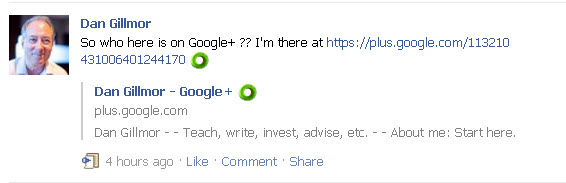
Google’s diffuse-by-invites strategy works fine for a tool like Gmail, which is evaluated purely as a feature set, but it won’t work for Google+. Evidence: my friend Dan Gilmore, who as an innovator and former reporter for San Jose Mercury News should have more Google+ connections than anybody, went onto Facebook to look for friends who might also be using Google+. With no luck.
It doesn’t matter to you if 1 million or even 100 million people are using a social network, if only one of your 20 key colleagues and friends are using it. With social networks, it takes at least three to tango.
3) Diffuse launch path. Social networks can ONLY start small and tight with a set of enmeshed users, then percolate slowly outward. Facebook started in a Harvard dorm, then spread across Harvard, then to Stanford, Columbia and Yale. Then other Ivy League schools. Then colleges across the US. Then high schools. Then Microsoft and Apple. Only then, 30 months after launch, was Facebook opened up to everyone.
Likewise, Twitter started with messages between Biz Stone, Ev Williams and Jack Dorsey and their friends in San Francisco in March of 2003. It percolated there for a year, before expanding in March of 2007 into the tightly networked SXSW crowd, folks who were hungery for a way to recreate and sustain their SXSW friendships when they left Austin. That crowd, in turn, evangelized to their social network savvy friends at businesses across the US.
For both Facebook and Twitter, initial users were tightly networked. There was a strong sense of clubbiness among community members through a long initial phase. Those members’ loyalty to the club withstood even repeated outages (on the part of Twitter) and privacy concerns (on the part of Facebook) that would have doomed a normal technology product.
4) Noisy feedback loops. One of the key reasons that launching big is fatal to social networks is because the feedback loop from users to designers to users to progammers to management to newbs to old-timers to programmers gets cluttered with noise. When a tool launches big, its designers end up trying to build a feature set that satisfies all communities — or their own peculiar whims. Most users end up with a luke-warm affection for the service. There’s no ‘sponsor’ community to advocate change or evangelize.
MIT professor Eric Von Hippel has amply documented the importance of users in driving innovation in technology domains as diverse as thermoplastics, semi-conductors and scientific instruments. Is there any doubt that user innovation would be even more crucial in shaping social networks, where the user and the product are so closely entwined, functioning as two ends of the same biocyber synapse?
Rather than launching big and broad, far better to build a “small” tool for one passionate community. Once the kinks get worked out, this template of technology and usage patterns later gets adopted/adapted by other adjacent communities. Using this approach, people like to feel they’re in a human-sized space in which their actions matter, in which their feedback into the system gets processed and used. (Gordon Moore’s book Crossing the Chasm is awesome about this process.)
(It’s worth noting that Robert Scoble thinks Google+ is just for geeks and will survive by serving that market alone. I think geeks don’t just want to socialize with geeks… for long.)
5) Professional managers. Successful social networks evolve over time, often blossoming out of series of random, non-linear, unpredictable connections and chemistry. In retrospect, the winner’s strategy looks obvious (read Duncan Watts’ book!), but at any given moment, it is impossible to determine what feature set or user base will drive the coming decade’s NEXT dominant social network.
Professional managers, particularly of software projects, can’t tolerate this kind of nonlinear growth. In his post about Google+, Jason notes that he wrongly predicted huge success for Wave, Google’s previous attempt at social software launched with great fanfare two years ago, because Google ultimately stopped devoting resources to Wave. Why should things be different this time? Google is a big public company that needs high-profile successes not meandering muddles that may eventually pay off. This means Google will likely give up on Google+ before it can take root, just like it killed Wave. Clayton Christensen’s brillian book Innovator’s Dilemma gives the playbook.
6) No culture. Starting big and broad also kills the chance for a social network to develop a distinctive culture. This is crucial because a great social network is known by its culture, its lingo, its behaviors, its taboos, its history. Some examples:
Overwhelmed by the volume of information flowing from Twitter, Tweeters (not Twitter) created hashtags to keep track of ideas.
Back in 2004, the liberal blog DailyKos was playing a key role in narrating and steering the Democratic party’s primaries. The site was getting lots of favorable press, and I asked Markos Moulitsas, the community’s creator and curator, whether this attention was having a big positive impact on the community. On the contrary, Markos replied. Every time there was big press about the site, the community would flood with new users who didn’t get the site’s culture. Traffic would spike briefly, but interaction quality would plummet. A big gush of new members busted the site’s chemistry. Then DailyKos would shrink back to its previuos size and start growing organically again. Since then, the Kos community’s richness has spawned its own yearly convention.
(Another example of Kossite culture: to this day, a novel ad campaign can’t run on DailyKos without invoking communal cries of “pie fight,” an insider reference to an infamous, bodacious 2005 ad campaign by Turner Broadcast for a Gilligan’s Island reality show.)
For another example of how growth can kill a social network’s culture, look no further than the Q&A community Quora‘s explosion/implosion early this year. Once a steadily growing service, rich with VC and tech insiders, Quora suddenly went viral in January. New users flooded into the service and quality of interactions plummeted. Despite lots of agonizing over how to sustain the growth, http://quorareview.com/2011/01/27/evolving-quoras-design-for-growth/ the site has fallen back to earth.
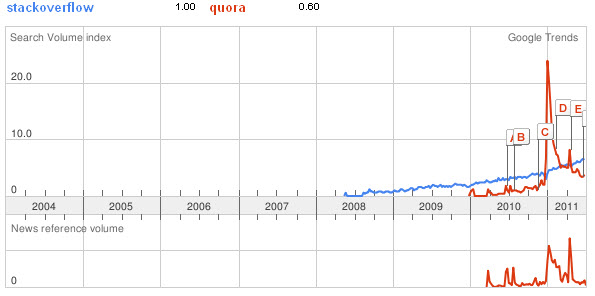
In contrast, the Q&A service Stackoverflow, which is tightly focused on serving specific communities and growing organically for the last three years , has overtaken Quora. Notice in the Google trends graph for the two services that Quora has gotten a huge amount of press (bottom trend box), but Stackoverflow is now far bigger.
Am I a Luddite or Google-hater? Judge for yourself. I started tweeting in March of ’07. I was LinkedIn’s 4,154th user. I even own a few Google shares — their ad business is a money-printing machine.
Summing up: Google’s great at carpentry. Gardening, not so much.
6/11/11 UPDATE: Facebook pulled down the Nicole Bally profile overnight. I wonder what was Facebook’s definitive evidence in making the call to delete… or was the profile just an embarrassment for supposedly savvy media figures, Silicon Valley insiders and Facebook itself, better erased than learned from? As of last night, 11 of 697 Bally’s friends — including Jimmy Wales, Eli Pariser, Peter Shankman, Jake Dobkin, Andrew Raseij — had owned up to their mistake, unfriended Bally and gained some wisdom from the encounter. Too bad more CEOs, Facebook board members, journalists and tech insiders didn’t get to make the same hard call in public. Meanwhile Celia Richards’ profile, with its misleading photo, is still intact.
Think it’s only old men in trench coats and — ahem — congressmen who like to share intimate moments with attractive strangers?
Based on my own Facebook experience, I’ve seen at least 100 influential tech, media and politics folks — men and some women — accept friend requests from attractive women they don’t know. For as long as three years, these supposedly savvy folks have been having personal conversations and sharing photos online in front of strangers that few (if any) of them know personally. And they are, inadvertently, sharing lots of their friends’ private data with these strangers.
These people are in the tech, media and political digital elite. They should know better, right? They include professors at Harvard, Columbia, NYU, CEOs and execs at Internet companies, e-consulting firms, ad networks, and PR companies. They include senior journalists and editors at places like the New York Times, the Wall Street Journal and the New Yorker. Details below.
It’s possible that one or more of the winsome Facebook profiles who these e-savants have friended are robots — bimbots? — who exist only to spy on their influential friends’ private lives.
Who is the tech and media elite eagerly friending? Let’s start with the Facebook profile of one Nicole Bally.

Does anyone out there actually know Nicole Bally? Please write me ASAP if you do. Though Facebook says she’s got 697 friends, I suspect she doesn’t exist or, at least, isn’t operating on Facebook under her real name or photo. I left a message on Nicole Bally’s wall yesterday asking where she works, but haven’t heard anything back. Hello Nicole Bally, are you out there?
Nicole Bally’s list of Facebook friends includes people like Sean Parker, Arianna Huffington, Dana Milbank, Joichi Ito, Chad Hurley, Chris Anderson, Henry Blodget, James Fallows, Jeffrey Toobin, Camille Paglia, Curtis Sliwa, Jimmy Wales, John Dickerson, Loic Le Meur, Seth Godin, Amanda Congdon, Jim Kramer, Howard Kurtz, Steve Case, Pete Cashmore, Andrew Ross Sorkin, Tim Draper, Nouriel Roubini, Jim Breyer, Sarah Lacy, Vint Cerf, Wes Clark… the list goes on and on. Here’s the full list.
You’ve almost got to worry if you’re NOT on the list of Nicole Bally’s friends.
Nicole Bally sent me a friend request a while back and I almost fell for it. Hey, 40 people who I know and trust are her friends. Apparently.
When I finally friended Nicole Bally back yesterday (to further this investigation!) I discovered that roughly 99% of the posts on her Facebook wall are simply people accepting her friend requests. Some guys muster up an eager “hey, let’s have lunch sometime!”
Do the tech and media elite actually look at Nicole Bally’s wall posts before accepting her friend request? Among her very few personal posts over the course of three years are several about mywebpost.com.
Nicole Bally’s photo albums feature just three generic images posted in March of 2008 shortly after she joined Facebook, one of Mark Zuckerberg and two stock-photo-like images from March 2008, one subtitled “A wonderful time with a wonderful friend” and the other “The most beautiful place in the world.”

I’ve done more hunting online, but can’t find anything solid about Nicole Bally. Surely if she works in media or advertising in NYC or San Francisco and knows so many famous-for-pixels people, she would show up on LinkedIn or someone’s Flickr photo album.
Do any of you know Nicole Bally? If not, why have so many of you friended her and why are you sharing your private lives with her?
When a colleague of mine looked around online for other instances of Nicole Bally’s profile photo, using the nifty photo identification service TinEye, he discovered that Nicole Bally’s Facebook profile photo looks like a cropped photo of Nicole Carroll, a fitness trainer.
Maybe Nicole Bally — some of her Facebook friends are weight lifters — is actually Nicole Carroll? Maybe the whole FB page is a subtle marketing ploy for a future, tech-celebrity-focused pivot for Crossfit Training, where Nicole Carroll works. Much more likely, Nicole Carroll is a hard-working, innocent person whose image has been stolen.
It would be a relief to know that Nicole Bally is a real person and not a stolen photo and a made-up name.
Except I’d still be left wondering why so many tech, politics and media people friended Nicole Bally without having ANY idea who she is or what she’s peddling.
Then there’s Celia Richards. Facebook keeps suggesting I may know Celia and should become her friend. After all, we know 24 people in common, many of them media insiders.
Again, some Googling turns up nothing solid about Celia. Given the e-fluential crowd she apparently hangs with, Celia seems like a digital playa. But she’s got no digital fingerprint outside the walls of Facebook.

Is Celia real or just a bimbot created to harvest personal info — wall posts, friendships, photos, demographic information — from her credulous yet influential friends and their friends?
I don’t know for sure. But some more sleuthing reveals that Celia’s profile pic is actually a photo of TV star Kristin Cavallari. Duh! Maybe that’s why I don’t recognize her as a friend.
Perhaps Celia really exists, but just prefers to pretend she looks like Kristin. (Contrary to Facebook’s terms, BTW.) I’ll know more if she ever accepts my friend request.
If these Facebook profiles are not bona fide, what’s the real game? Theories vary, from comic to creepy.
Dude you guys it is the government. They lure you in with seductive women (or men if you are female) and they try to get information out of you without interrogation but with chatting.
Or maybe we’ve just stumbled into an elaborate, long-festering online version of the famous foreover alone flashmob?
More prosaically, Harvard Kennedy School professor Steven Kelman writes:
My guess is that somebody is setting up Facebook accounts with nonexistent (or hired) attractive women, and sending out large numbers of friend requests to guys with the hope that many will accept the request. (For all I know, similar requests, with attractive guys, are being sent to women.) Once you accept their friend request, they gain access to a lot of information about you…
We all know that companies in the past were very eager exploiting holes in FB’s architecture to scrape personal information.
Even after Facebook tightened up its privacy settings, it seems clear that people are blithely sharing way too much of their lives with people they haven’t fully vetted. And it seems likely that our conversations are being spied on, recorded and analyzed, either by folks from China or by corporate sleuths hiding behind seductive masks to track and influence conversations about their clients, customers and competitors.
Congresstwerp Andy Weiner put way too much online.
Don’t laugh. You may be sharing way too much with strangers too.
UPDATE: Dabitch offers more theories for who Nicole Bally and the army of bimbots could be working for at adland.tv. And Jesse Brown expounds on the power of the mutual friends list at Macleans.ca.
Here are a few of the top tweets on the matter:


It’s hard to believe that 2011 is almost halfway over. Blogads’ designers and developers have been super-busy, rolling out new features to help advertisers connect with influential blog readers. Here are some highlights from the last six months.
Tweetable Ads
We added tweetability to our ads in January. With the click of a button, advertisers can add a “tweet this” button that automatically suggests a twitter update, complete with URL and hashtag. This feature is already one of our most popular, and you can see how successful it’s been for two of our advertisers: PETA and Simon & Schuster. Even President Obama used it to kick off his 2012 campaign!


